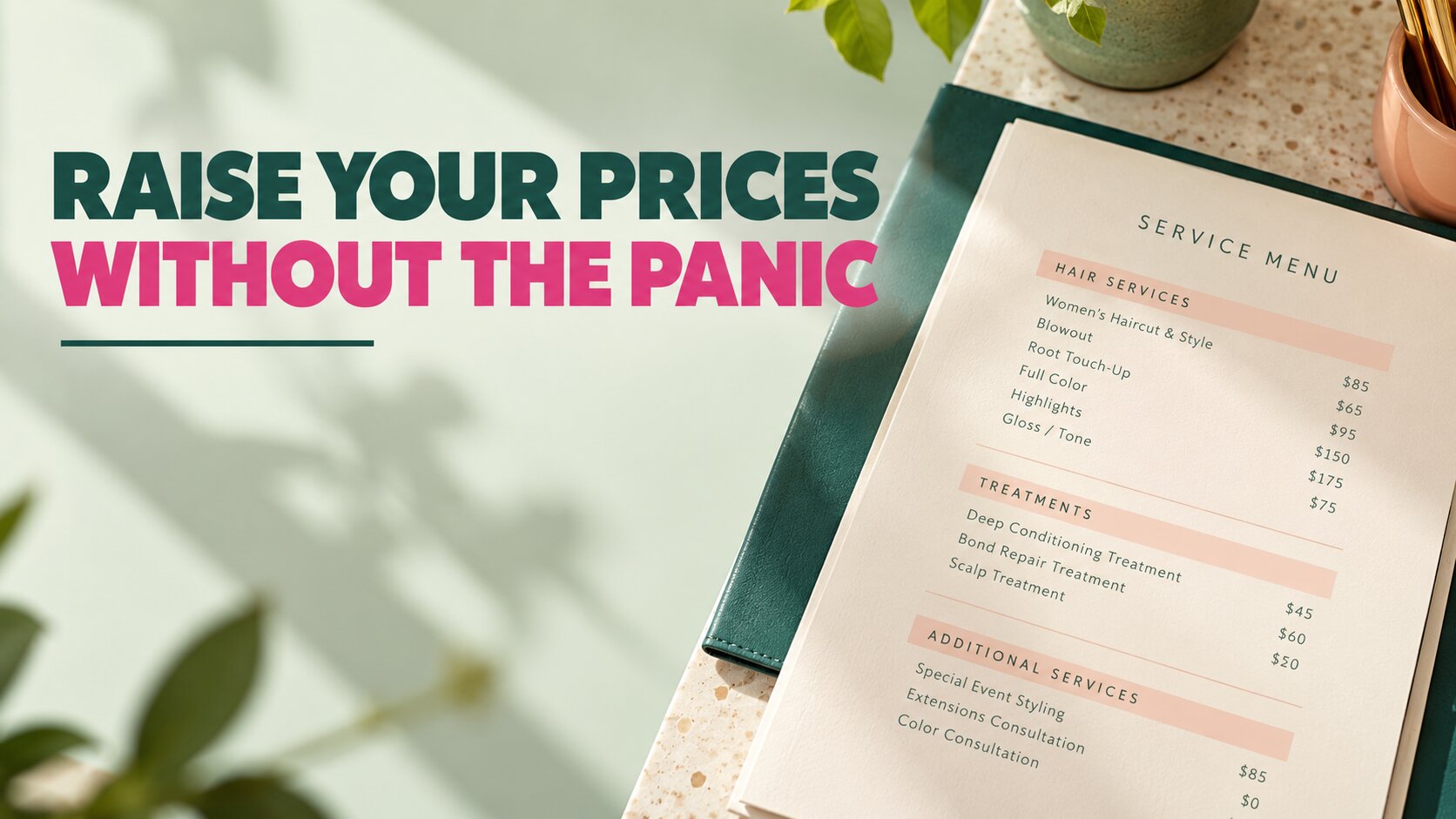
If you’ve been putting off a price increase for a year or two, you’re in good company. Almost every owner I talk to has a version of the same story. Product costs went up. Rent went up. The team got a raise, or needs one. And the menu still says the same thing it said in 2023.
The fear is always the same, too: “What if people leave?”
Some might. That’s the honest answer. But far fewer than you think, and the ones who stay will be paying what your work is actually worth. Let’s walk through how to do this without the drama.
The fear is always the same, too: “What if people leave?”
Some might. That’s the honest answer. But far fewer than you think, and the ones who stay will be paying what your work is actually worth. Let’s walk through how to do this without the drama.
Start By Knowing Your Real Number
Before you touch the menu, figure out what it costs you to deliver a service. Not a guess. The actual cost.
For a color service, that means product used, the stylist’s time at their real pay rate, the backbar, the towels, and a slice of rent and utilities for that chair for that hour. For a facial, it’s product, the esthetician’s time, linens, room turnover, and the same slice of overhead. For a med spa, it’s the provider’s time, consumables, and the cost of the support staff who make that appointment run.
Most owners who do this for the first time find at least one service that’s barely breaking even or actually losing money. That’s not a failure. That’s information. Now you know which prices need to move the most.
For a color service, that means product used, the stylist’s time at their real pay rate, the backbar, the towels, and a slice of rent and utilities for that chair for that hour. For a facial, it’s product, the esthetician’s time, linens, room turnover, and the same slice of overhead. For a med spa, it’s the provider’s time, consumables, and the cost of the support staff who make that appointment run.
Most owners who do this for the first time find at least one service that’s barely breaking even or actually losing money. That’s not a failure. That’s information. Now you know which prices need to move the most.
Don’t Raise Everything By The Same Percentage
A flat “10% across the board” is easy, but it’s lazy. It over-raises the services that were already priced right and under-raises the ones that were bleeding.
Look at each category. Maybe your haircuts are fine and your color needs a bigger bump. Maybe your basic facial is priced right but your advanced treatments have been a giveaway. Adjust where it matters.
Look at each category. Maybe your haircuts are fine and your color needs a bigger bump. Maybe your basic facial is priced right but your advanced treatments have been a giveaway. Adjust where it matters.
Pick A Date And Stick To It
Decide when the new prices start. Give yourself enough lead time to update the booking software, the website, the menu, and the team, but don’t drag it out. Four to six weeks of notice is plenty for most businesses.
Then put it on the calendar and treat it like a real deadline. Price increases that float (“we’ll do it after the holidays, or maybe spring”) tend to never happen.
A lot of owners like to time it with a natural marker, like the start of a new year or the anniversary of the business. That’s fine. It’s also fine to just pick a Tuesday.
Then put it on the calendar and treat it like a real deadline. Price increases that float (“we’ll do it after the holidays, or maybe spring”) tend to never happen.
A lot of owners like to time it with a natural marker, like the start of a new year or the anniversary of the business. That’s fine. It’s also fine to just pick a Tuesday.
Tell Clients Plainly, Then Stop Talking
This is where people get in trouble. They over-explain. They apologize. They write a three-paragraph email about inflation and supply chains and how hard it’s been.
Your clients don’t need that. They need to know what’s changing, when, and that you appreciate them. That’s it.
Your clients don’t need that. They need to know what’s changing, when, and that you appreciate them. That’s it.
A Simple Way To Say It
Something like this works for an email, a text, or a note at the front desk:
“Starting [date], our service prices will be updated. You’ll see the new pricing on our website and booking page. Thank you for trusting us with your care. We’re glad you’re here.”
Short. Warm. No apology. No excuses.
You can add one sentence about continuing to invest in your team and your products if you want, but keep it to a sentence. The moment you start justifying, you invite negotiation.
“Starting [date], our service prices will be updated. You’ll see the new pricing on our website and booking page. Thank you for trusting us with your care. We’re glad you’re here.”
Short. Warm. No apology. No excuses.
You can add one sentence about continuing to invest in your team and your products if you want, but keep it to a sentence. The moment you start justifying, you invite negotiation.
Where To Announce It
Send an email to your client list. Post it on your booking page. Put a small, clean card at the front desk. Mention it in your confirmation messages for a few weeks. If you post on social, keep it low-key and matter-of-fact. This doesn’t need to be a campaign.
What you don’t need to do is call every client individually or catch them at checkout and explain. The team will handle in-person questions (more on that below), and most clients honestly won’t say anything.
What you don’t need to do is call every client individually or catch them at checkout and explain. The team will handle in-person questions (more on that below), and most clients honestly won’t say anything.
Tell Clients Plainly, Then Stop Talking
Your front desk and your service providers will hear about the price increase before you will. If they’re uncomfortable, clients will feel it.
Sit down with the team before the announcement goes out. Tell them why the prices are moving and what it means for them. If the increase supports raises, better products, or better equipment, say so. People defend a decision they understand.
Then practice the conversation. Actually role-play it. What does the front desk say when someone at checkout says, “Wait, it was $85 last time”? What does a stylist say when a longtime client jokes, “Guess I’m paying for your vacation”?
The answer should be calm and short. “Yes, our pricing updated on the first. It’s on the website and the menu. Anything else I can help with today?” No defensiveness. No “I know, I’m sorry, it wasn’t my idea.”
Sit down with the team before the announcement goes out. Tell them why the prices are moving and what it means for them. If the increase supports raises, better products, or better equipment, say so. People defend a decision they understand.
Then practice the conversation. Actually role-play it. What does the front desk say when someone at checkout says, “Wait, it was $85 last time”? What does a stylist say when a longtime client jokes, “Guess I’m paying for your vacation”?
The answer should be calm and short. “Yes, our pricing updated on the first. It’s on the website and the menu. Anything else I can help with today?” No defensiveness. No “I know, I’m sorry, it wasn’t my idea.”
Decide In Advance What You’ll Do About Exceptions
Someone will ask for the old price. A long-time client. A friend of the owner. A regular who “always books the big package.”
Decide now, not at the front desk. Most businesses do best with a simple rule: new prices apply to everyone on the start date, and anything already booked before the announcement is honored at the old price. Clear, fair, and easy to explain.
If you want to give a soft landing to your very top clients, a small one-time thank-you (a complimentary add-on at their next visit, for example) is a nicer gesture than a permanent discount. Discounts you give quietly become expectations you can’t undo.
Decide now, not at the front desk. Most businesses do best with a simple rule: new prices apply to everyone on the start date, and anything already booked before the announcement is honored at the old price. Clear, fair, and easy to explain.
If you want to give a soft landing to your very top clients, a small one-time thank-you (a complimentary add-on at their next visit, for example) is a nicer gesture than a permanent discount. Discounts you give quietly become expectations you can’t undo.
Common Mistakes And What To Do Instead
Waiting Until It’s An Emergency
Owners who raise prices only when the bank account forces them to end up doing bigger, scarier jumps. Do smaller increases on a predictable rhythm, like once a year, and clients get used to it. It becomes a normal part of doing business with you, not a shock.
Raising Prices Without Raising The Experience
If the increase comes with sloppy service, a messy waiting area, or a front desk that doesn’t look up, clients will notice the gap. Tighten up the basics before the new prices go live. Greet people by name. Run on time. Follow up after the appointment. None of that costs money, and it makes the price feel earned.
Hiding The New Prices
Some owners quietly update the booking software and hope nobody notices. Someone always notices, and now it feels sneaky. Tell people. It’s more respectful, and it’s less stressful for your team.
Letting Service Providers Set Their Own Rules
If one stylist “just keeps charging the old price for her people,” you have two price lists and a fairness problem. Pricing is a business decision. The team should be part of the conversation, but the final call and the consistency belong to the owner or manager.
Counting The Wrong Thing
If two clients leave, it’s tempting to panic. Look at the bigger picture instead. How many clients came in this month? What was the average ticket? Are you busier or slower? Give it 60 to 90 days before you judge whether the change worked. One bad week isn’t the answer.
What Usually Happens
Most of the time, this is what owners tell me after the dust settles: a couple of clients grumbled, a few asked about it and then booked anyway, and the majority never mentioned it at all. The team was more nervous than the clients were. And the owner wished they’d done it a year earlier.
That’s not a promise. Every business is different. But the fear is almost always bigger than the fallout.
That’s not a promise. Every business is different. But the fear is almost always bigger than the fallout.
Conclusion
Raising prices isn’t about being greedy. It’s about running a business that can pay its people well, keep its lights on, and still be here in five years. Know your number, pick a date, say it plainly, and get your team standing behind it. Then get back to work.
If you’re staring at your menu and not sure where to start, or you’ve tried to raise prices before and it got messy, this is exactly the kind of thing to work through with someone who’s done it many times. Schedule a Strategy Session with an Empowering You Certified Consultant, and we’ll look at your actual numbers, build a pricing plan that fits your business, and help you prepare your team for the conversation. You can book here: https://empoweringyouconsulting.com/strategy-session/
If you’re staring at your menu and not sure where to start, or you’ve tried to raise prices before and it got messy, this is exactly the kind of thing to work through with someone who’s done it many times. Schedule a Strategy Session with an Empowering You Certified Consultant, and we’ll look at your actual numbers, build a pricing plan that fits your business, and help you prepare your team for the conversation. You can book here: https://empoweringyouconsulting.com/strategy-session/